

Almost every organization I talk to is building the same machine. A better website, sharper SEO, more consistent social, smarter paid campaigns, all in service of one goal: more qualified leads.
Qualified leads are people who know they need help, have a budget in place, and are already comparing options. There is nothing wrong with wanting them, but if they are the only people your marketing is designed to catch, you are fishing in a very small pond.
Professor John Dawes of the Ehrenberg-Bass Institute put a number on that pond in research published with LinkedIn’s B2B Institute: only about 5% of B2B buyers are in-market at any given moment. The other 95% won’t buy for months, or even years. A lead engine is tuned for the 5%. So is every one of your competitors’ lead engines.
With this in mind, the question isn’t “how do we get more buyers to find us?” The more useful question “what is stopping everyone else from showing up at all?” Some of the smartest companies I’ve studied answered that question with an acquisition. They didn’t buy more of what they already sold. They bought the thing that got people through the door.
A Reason To Show Up
In January 2022, The New York Times bought Wordle from its creator, Josh Wardle, for a price in the “low seven figures” (Boston.com / NYT) and quietly changed how people found the Times.
Think about what the Times was really selling: world-class journalism, behind a paywall, competing with every free feed on the internet. The product was never the problem. It was getting someone to come to the Times on an ordinary Tuesday, when nothing big was happening in the world, and feel at home once they got there.
Wordle removed that barrier. It was free, it took three minutes, and you could only play once a day, so people came back every morning. Once they were there, the Times could introduce them to Spelling Bee, the Crossword, and the rest of what it has to offer.
The results came fast. Roughly three months after the deal, CEO Meredith Kopit Levien reported that Wordle had brought tens of millions of new users to the Times, many of whom stayed to play other games. It drove the company’s best quarter ever for new Games subscribers (TechCrunch).
The habit has held over time. Wordle was played 4.2 billion times in 2025, roughly 11.5 million plays a day (A Media Operator). And notice what the Times did not do: it did not put the daily Wordle behind the paywall. You don’t charge admission at the front door.
Three More Companies That Bought the Front Door
Wordle isn’t a one-off. Look closely and you find the same move across different industries, each aimed at a different barrier.
Buying Attention a Vendor Can’t Earn
In February 2021, HubSpot bought The Hustle, a daily business newsletter with roughly 1.5 million subscribers, for a reported $27 million (Practical Ecommerce). On paper, a CRM (customer relationship management) company buying a newsletter made little sense.
The barrier here was attention. Founders and operators will happily start the day with a sharp, funny take on business news. A software company’s blog is a much harder sell. HubSpot’s CMO, Kipp Bodnar, said at the time that marketers would increasingly need to think like media companies (Marketing Brew).
HubSpot kept going. It added the newsletter Mindstream, then the founder-story brand Starter Story in February 2026. By then, HubSpot said its media network drove more than 50 million engagements and tens of thousands of leads every month (Demand Gen Report).
Buying a Reason To Visit More Than Once a Year
Intuit makes TurboTax. Most people use tax software once a year and forget about it for the other eleven months. In December 2020, Intuit closed its $8.1 billion purchase of Credit Karma, a company built on giving people their credit scores for free. CEO Sasan Goodarzi told Fortune the deal “was never about tax.” What drew Intuit was Credit Karma’s reach: 110 million members (Fortune).
A tax return is an annual chore, while a credit score is something people check whenever they think about a credit card, a car, or a home. Intuit bought its way into those everyday moments.
Buying the Know-How Buyers Lacked
Semrush sells SEO software. Its quiet barrier is competence: people don’t buy a professional tool for a discipline they don’t yet understand.
In January 2022, Semrush bought Backlinko, Brian Dean’s SEO training site, which drew about 500,000 organic visits a month. The stated goal was to grow Semrush Academy and educate the next generation of digital marketers (Search Engine Land).
Semrush went further still. It now owns Search Engine Land itself, along with the SMX conference series. In other words, it owns the places its future customers go to learn the craft.
The Pattern: Find the Barrier & Remove It
Each of these companies named the specific thing keeping good prospects away, then bought whatever made it disappear.
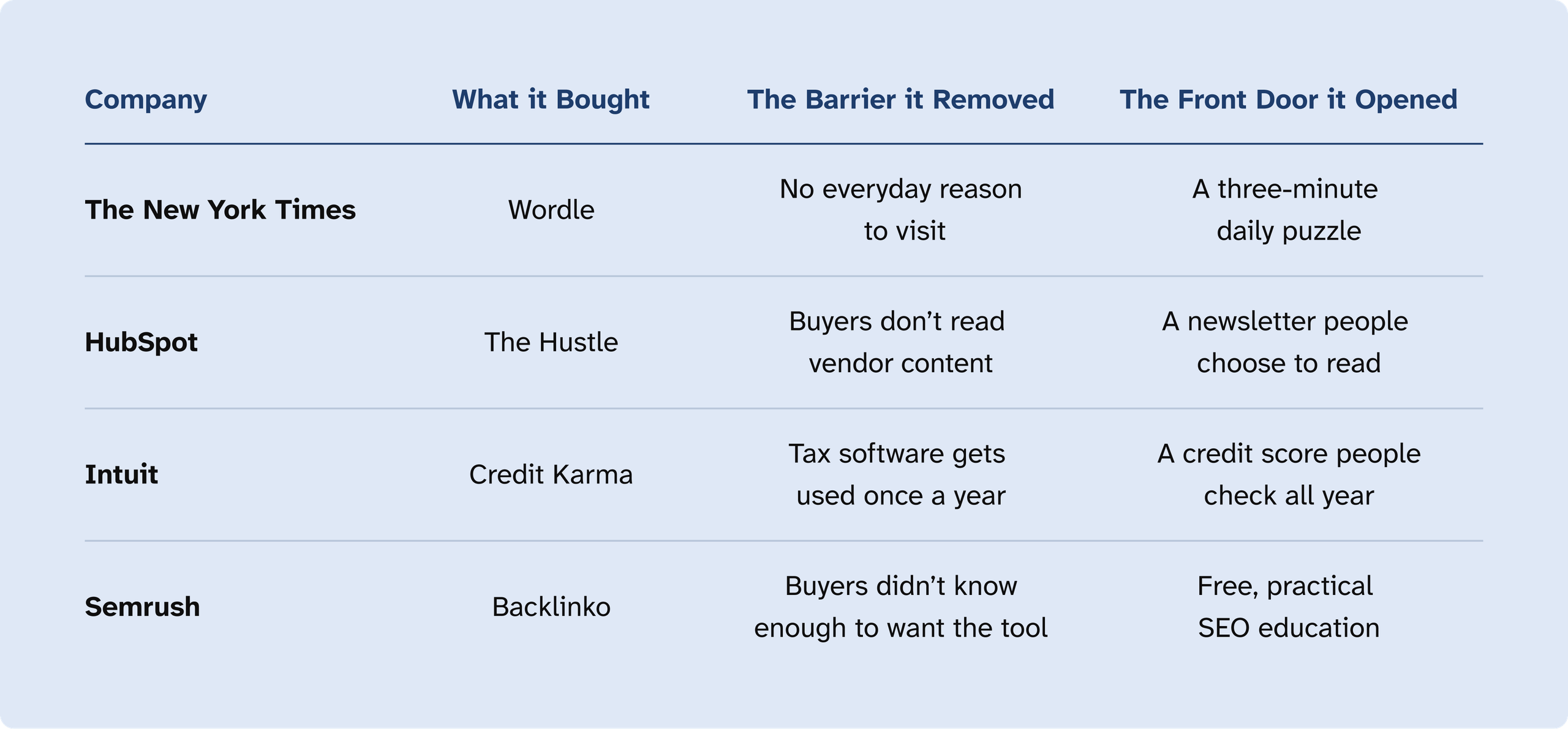
Look at the front doors and four things repeat:
- They’re free. No one paid to play Wordle, read The Hustle, check a credit score, or learn from Backlinko. The value comes first; the sale comes later.
- They’re useful on their own. Wordle is fun even if you never subscribe to the Times or their Games subscription. The Hustle is worth reading even if you never buy a CRM. That’s exactly why people trust them.
- They’re frequent. Daily puzzles, daily emails, regular check-ins. Familiarity gets built long before anyone has a budget.
- The buyer stays out of the way. The Times kept Wordle simple. HubSpot says its media brands kept their editorial independence. The moment the front door feels like a sales pitch, people stop walking through it.
What if You Sell Services, Not Software?
You don’t need $27 million, let alone $8 billion, to apply this. What matters is removing the barrier for the 95% who aren’t ready yet, instead of tuning everything for the 5% who are.
For those of us who serve mission-driven organizations, the barriers are familiar. Universities, public health agencies, nonprofits, and government teams often buy through formal procurement, so by the time an RFP is public, the shortlist already exists in someone’s head. Their teams are stretched thin and wary of risk. And many leaders can’t name what they need until a problem forces the issue.
A front door for that audience can take many forms, at almost any budget:
- Build one. A newsletter worth reading, a free tool, a benchmark report your sector waits for each year, a short course that builds a skill your clients’ teams lack.
- Borrow one. Partner with an association, foundation, or conference that already has your audience’s attention. Co-lead the session. Co-author the research.
- Buy one. Sometimes the fastest path is acquiring a newsletter, community, or tool that already has the habit you want.
Before your next marketing planning session, try asking your team:
- What do our best future clients do every week, long before they need us?
- What stops a good-fit organization from talking to us before an RFP goes out?
- What could we offer that is genuinely useful, even if they never hire us?
- Who already holds the attention of the people we serve, and how could we build, borrow, or buy our way in?
Stop Waiting at the Bottom of the Funnel
Lead generation asks, “Who is ready to buy today?” Barrier removal asks, “What would make the right people show up long before they’re ready?” The first question fights every competitor for the same 5%. The second builds a relationship with the other 95%.
The New York Times needed more people stopping by every morning. Once Wordle opened that door, the subscriptions followed.
What barrier is keeping your best future clients from walking through your door? Let me know what you’ve tried.