

In the digital era, being “findable” online is not an accident; it’s the result of strategic thinking, rigorous process, and constant adaptation. Yet, as user behaviors have shifted and new technologies have exploded onto the scene, winning the search game is no longer about just checking off standard SEO boxes.
At Proven, we believe modern visibility requires not only technical and creative excellence, but also a strategic embrace of three overlapping disciplines: SEO (Search Engine Optimization), AEO (Answer Engine Optimization), and GEO (Generative Engine Optimization).
If you’ve seen these acronyms and felt a twinge of confusion, you’re not alone. While SEO may be familiar territory, AEO, and GEO are rapidly becoming just as crucial for success. This guide is designed to clarify what each one is, how they differ and intersect, and most importantly, how Proven bakes best practices for all three into every aspect of our work.

What is SEO & Why Is It Still Foundational?
At its core, Search Engine Optimization (SEO) is about making your website and content as discoverable and appealing as possible to traditional search engines like Google and Bing.
For years, successful SEO has meant skillfully researching the keywords your target audience is using, structuring high-quality content around those keywords, and ensuring your site is technically sound — fast, secure, mobile-friendly, and easy to navigate. It also means building authority and credibility, so search engines understand you’re a trustworthy source worthy of a top ranking.
Over time, effective SEO has evolved. Tactics that worked well a decade ago — like keyword stuffing or link farms — are long obsolete. Today’s SEO incorporates dozens of subtle signals, from semantic context to Core Web Vitals, and rewards brands that deliver value, clarity, and a seamless experience for users.
At Proven, we focus on the building blocks that never go out of style:
- Deep-dive keyword and intent research
- High-quality, long-form and multimedia content
- Technical excellence (speed, security, mobile optimization)
- Authority and trust-building via backlinks and digital PR
- User experience layered throughout every touchpoint
SEO is still the starting line, but today, it’s no longer the entire race.
What Is AEO & Why Should You Care?
Answer Engine Optimization (AEO) takes the next step, shaped by the explosion in popularity of voice search, smart speakers, virtual assistants, and direct answer features in search results. Increasingly, users aren’t just looking for a list of blue links, they want the right information, in the right format, right now.
AEO is about helping these engines surface the best answers drawn from your content. It begins with understanding exactly what your audience is asking and architecting your content to deliver precise, schematically marked-up answers — whether via FAQ sections, step-by-step guides, or Q&A style formats. Here’s how Proven approaches AEO within each content build:
- Identify and research user-driven questions.
- Structure content to provide direct, concise answers early on.
- Apply relevant schema and structured data (FAQ, HowTo, Article).
- Monitor and adapt based on how often your answers are being surfaced in snippets or voice results.
Optimizing for AEO elevates your brand beyond the SERP (Search Engine Results Page). You become the resource that digital assistants and answer engines rely on, meaning more direct engagement and top-of-mind awareness, sometimes without a single extra click.
Understanding robots.txt and llms.txt
It’s worth clarifying a common point of confusion: robots.txt and llms.txt are not competing standards — they operate on entirely different layers.
robots.txt functions as server-level access control, determining whether an AI crawler is permitted to visit your site at all.
llms.txt, by contrast, acts as a curated roadmap for the crawlers you’ve already allowed in, pointing AI models toward your most authoritative, fact-dense content.
For AEO purposes, the best practice is to use both: explicitly allow the AI bots relevant to your visibility goals while blocking those you don’t want accessing your content.
That said, robots.txt compliance is not guaranteed. While most AI crawlers honor its directives, a growing number do not — an issue increasingly reported by high-traffic publishers and institutions alike. Perplexity is a notable example: it operates two distinct bots serving different functions. One handles general indexing and respects robots.txt. The other, used specifically for real-time query inference, does not. Even where llms.txt adoption is still emerging — major AI platforms have not yet officially committed to parsing it — maintaining the file is sound discipline. It forces a useful internal audit, ensuring your canonical content is clean, well-structured, and ready for AI consumption regardless of how platform standards evolve.
What is GEO & Why Is It the Next Competitive Frontier?
The digital search world is evolving again with the rapid expansion of generative AI tools, like Google’s Search Generative Experience (SGE), Microsoft’s Bing Copilot, and popular AI chatbots.
Now, users expect search platforms to pull together comprehensive answers, recommendations, or plans, synthesized from reputable sources and summarized by AI — often citing your content, but in a wholly new context.
Generative Engine Optimization (GEO) responds to this transformation by making sure your content is not only accessible to these AI tools, but consistently used in their outputs. GEO focuses on crafting content that is structurally clear, frequently updated, and easy for AI to ingest, interpret, and cite. Some of the tactics Proven uses for GEO include:
- Ensuring content is formatted for both humans and machines (e.g., organized headings, lists, and tables)
- Maintaining up-to-date information and authoritative, well-cited sources
- Embedding rich metadata and schema so AI knows exactly what your content means
Ultimately, GEO prioritizes both clarity and credibility. When AI engines seek answers or sources, your content should be the one they synthesize and mention, building authority in the next generation of search.
Why JSON-LD Structure Matters for GEO
JSON-LD deserves particular attention here. Embedded directly in a page’s HTML header, it converts your content into structured data that AI models can parse explicitly — rather than leaving them to infer meaning from prose. Instead of an AI model analyzing your writing to determine what a page is about, JSON-LD states it directly: a product’s price, rating, availability, and manufacturer are declared as machine-readable facts, not assumptions.
Structure within that schema matters just as much as its presence. Flat, siloed JSON-LD — where, say, an organization schema exists independently of a product schema — misses the relational context that AI models actively seek. Nested, hierarchical schemas that connect organization, product, pricing, and reviews into a unified structure reflect how these models actually process information: not linearly, but through entity relationships and mappings. The result is an AI that immediately understands the full context of a page without gaps to fill or guesses to make — directly reducing the likelihood of hallucinations in generated outputs.
SEO vs. AEO vs. GEO: Key Differences & Overlap
While SEO, AEO, and GEO share core optimization principles, each targets a distinct landscape. Understanding their alignment and divergence will help you future-proof your content strategy. Here’s a comparative snapshot:
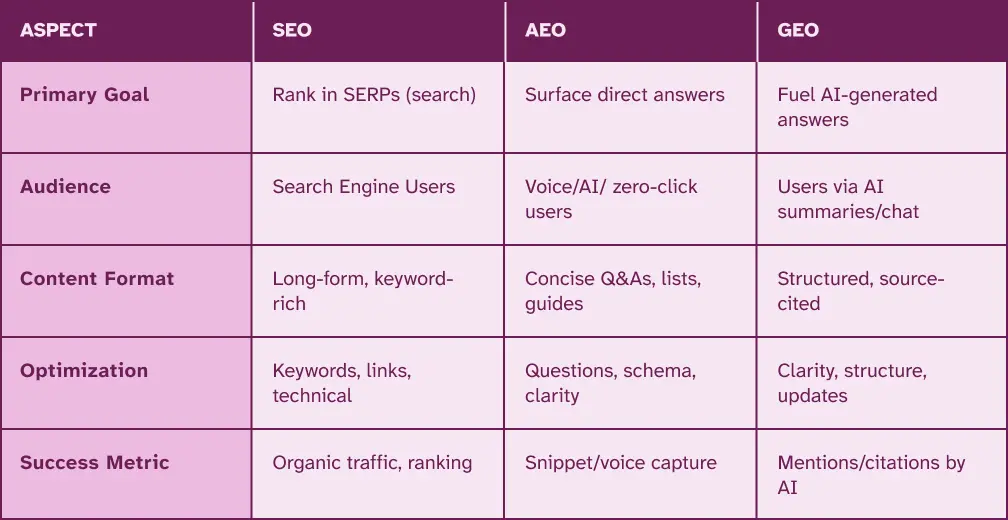
At Proven, we recognize and leverage their intersections. Authoritative, expertly structured content often excels across all three areas — but subtle nuances in how content is crafted, marked up, and maintained can make the difference between being merely present or truly dominant.
Proven’s Approach: Multi-Engine Optimization
Proven’s process is rooted in holistic, user-centric optimization. Every project, from initial research to post-launch analysis, is built with all three optimization fronts in mind.
First, our research phase digs deeper than simple keyword lists. We map out not just what your audience searches for, but how they phrase their questions, what related queries arise in AI and voice environments, and which gaps exist in existing generative outputs. This gives us a multi-dimensional view of demand, allowing us to prioritize topics and formats proven to perform in classic search, answer features, and emerging AI interfaces.
In content creation, writers and editors collaborate closely, following checklists that bake the following best practices into every asset:
- Place succinct answers to frequently asked questions near the top of the content.
- Break complex information into digestible lists, steps, or tables for easy extraction by both answer engines and AI bots.
- Use schema markup (FAQ, HowTo, Article, Product, etc.) to signal structure and relevance.
- Employ authoritative, well-sourced citations to build trust for both human users and AI analysis.
Technical teams ensure nothing stands in the way of visibility. That means optimizing for speed, mobile-first delivery, crawlability, and accessibility — as well as embedding up-to-date metadata and structured data. We routinely audit sites for gaps in schema or potential barriers to AI engine access.
Measurement at Proven goes beyond basics; we employ an analytics toolkit that tracks:
- Organic ranking and keyword movement (SEO)
- Featured snippet and voice answer capture (AEO)
- Mentions of your content in SGE/AI summaries (GEO)
- On-site and off-site engagement, measuring both classic clicks and next-gen reach
Finally, we use those insights to refine editorial guidelines, update existing pages, and prompt new opportunities as the digital landscape inevitably shifts.
Repeatable Processes for Reliable Results
A multi-engine strategy at Proven is woven into every step, from briefing through to publication and promotion. Our workflow is a blend of research, creative, technical, and analytic disciplines working in sync.
- Content Briefing & Strategy: Each assignment contains a balance of keyword goals (SEO), question mapping (AEO), and citation-readiness checks (GEO).
- Content Creation: Writers and designers apply clear structures, multi-format answers, and schema-friendly layouts, always with the user’s search journey in mind.
- Technical QA: Every launch is measured against our proven technical, accessibility, and schema checklists.
- Review & Iteration: Results from search analytics, snippet monitoring, and AI output tracking feed directly back into the next round of improvements.
By embedding these cross-disciplinary approaches into our culture, Proven ensures no aspect of organic visibility is left to chance.
Future-Proof Your Organic Search Strategy
Success in digital search no longer depends on one approach or platform. At Proven, we ensure our clients’ content is ready for every scenario: ranking on page one (SEO), surfacing as the top answer (AEO), and powering tomorrow’s AI-driven search journeys (GEO).
By blending strategy, creativity, and technical rigor, we help you become not only discoverable but truly indispensable in every engine and every era.
At the center of our work is the humanity that connects us all – including our experts and yours. Let us craft proven solutions for your most pressing challenges.
Related Insights