
There’s a fundamental shift occurring in the design industry with the rollout of AI. For decades, agencies and designers have made execution and production a core piece of their services. Since the beginning of the modernist design movement in the 20th century, production has always been a necessary part of the design process, where long hours of manual labor were needed to create a viable product.
As the focus moved beyond print to include digital, manual labor remained crucial despite the different medium. Now, in the era of AI, when these processes can be partially or fully automated, many are wondering: in a world where a single prompt can generate an entire website, what is the role of design?
Slowing Down to Get Ahead
With generative AI now available to anyone with a subscription, we’re seeing companies increasingly outsourcing their design needs to AI. However, it is critical to note that the value that design provides is far more than just the creation of the final artifact. As Gess Puglielli, Head of Product Design at MPB, explains, a product is the deep understanding of human behavior that includes psychology, culture, invention, usability, and communication. Here at Proven, our question became: “how do we ensure that these core pieces that contribute to a successful product are retained when we use AI?”
While we wanted to harness the power of AI, we knew through our research and testing there were fundamental risks to outsourcing all of our design work to AI. The first is an understanding that, by its nature, AI on its own is incapable of innovation. Most effective at pattern recognition, mimicry, and volume, the designs it creates are the mean of its cumulative pool of reference material, so what you end up with is an averaging of a solution rather than one tailored to your client.
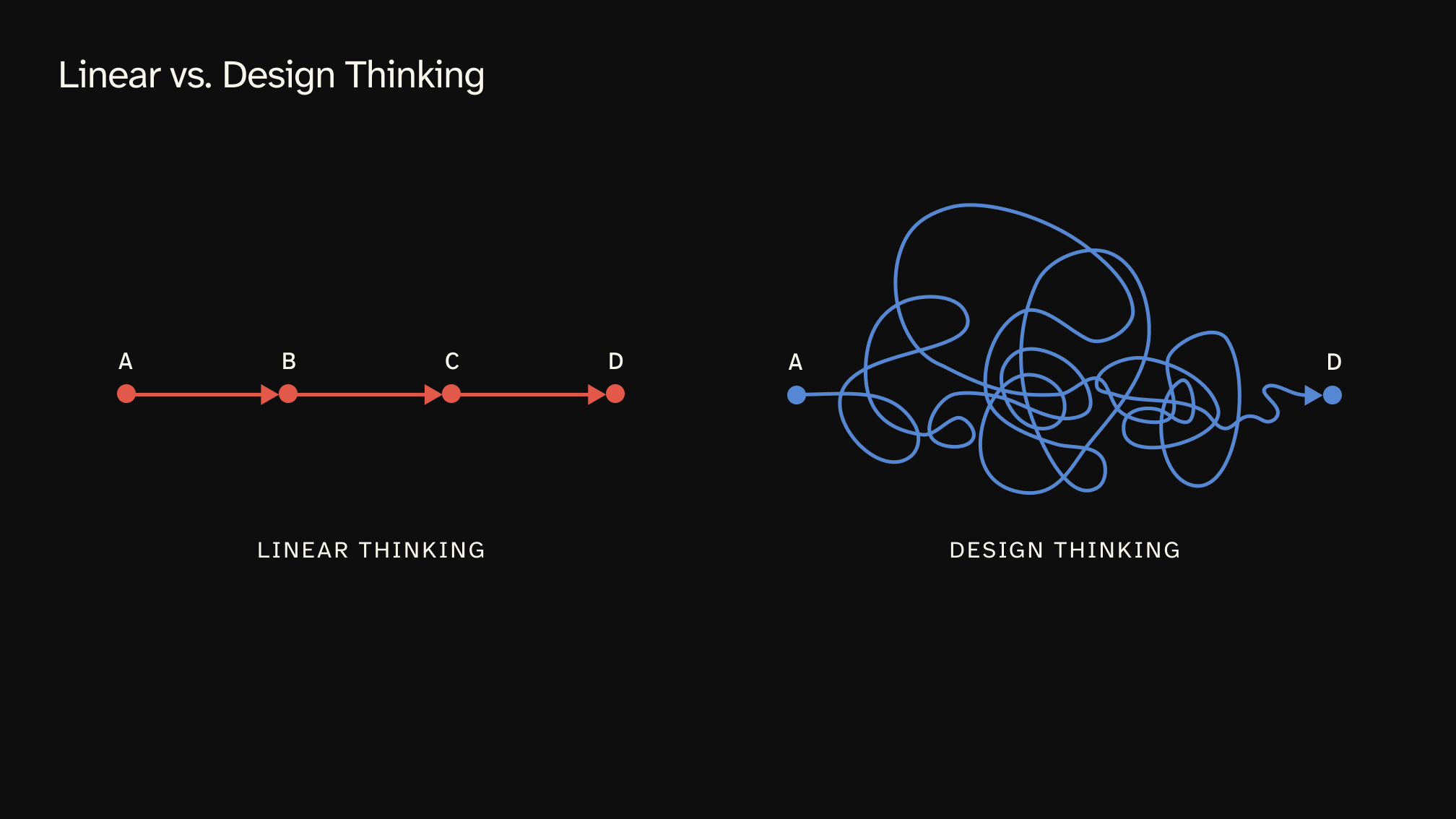
Effective design, by contrast, requires Design Thinking: a non-linear, human-centric process of exploration, empathy, and judgment. Designers don’t just duplicate what came before, they react to trends, push the limits of what’s possible, and create products and experiences never seen before. As the New Yorker reports, this is why this latest wave of AI tools is leading to a new landscape filled with generic, indistinguishable products, making Design Thinking a competitive differentiator that AI can’t replicate.
The second risk we identified is what is commonly known as the Black Box problem. The complexity of models, the lack of transparency around their training sources, and their ability to hallucinate clouds our ability to understand the decisions that AI makes and prevents us from trusting its answers when we ask for explanations. As we’re the ones ultimately accountable for and to the work, it was important to us that we maintain control over decision-making and guided strategy at all times.
The final risk we evaluated was the possibility that prolonged usage of AI would lead to skill erosion on our team. As with any skill, the more AI performs it for you, the less practice you have. With time, those creative muscles eventually atrophy. It was critical that our team maintains the ability to ideate and develop new solutions, but this also ensures that when the team does use AI, they can adequately supervise it.
Faced with these risks, we made a conscious choice at Proven. Our tools must always be in the service of our people, never the other way around. We intentionally built AI into the foundation of our workflows, but ensured that our strategic judgment is preserved. This choice means that our team will always be in command of steering the ship while still allowing us to experience the efficiencies and speed of AI, guaranteeing our partners that Proven’s track record of quality products would continue.
Human-Led AI in Action
When adopting this philosophy on the Creative team, our goal was to develop a relationship with our AI tools so together we could produce something greater than what could be done alone. To do so, we took guidance from AI transformation specialist Sharon Gai, and developed a clear litmus test for when to use AI tools in our work:
When We Use AI: When it improves our decision-making speed, when it eliminates work that used to create bottlenecks, and when it lets us produce things that would otherwise be impossible or impractical.
When We Do Not Use AI: We do not outsource our thinking. Using our experience and judgment, we bring a point of view to the work first — and only then use AI to challenge and refine that view.
Following these guidelines has helped us determine which AI tools to adopt, and which to ignore, regardless of how flashy they may appear to be.
Differentiation in the Age of AI
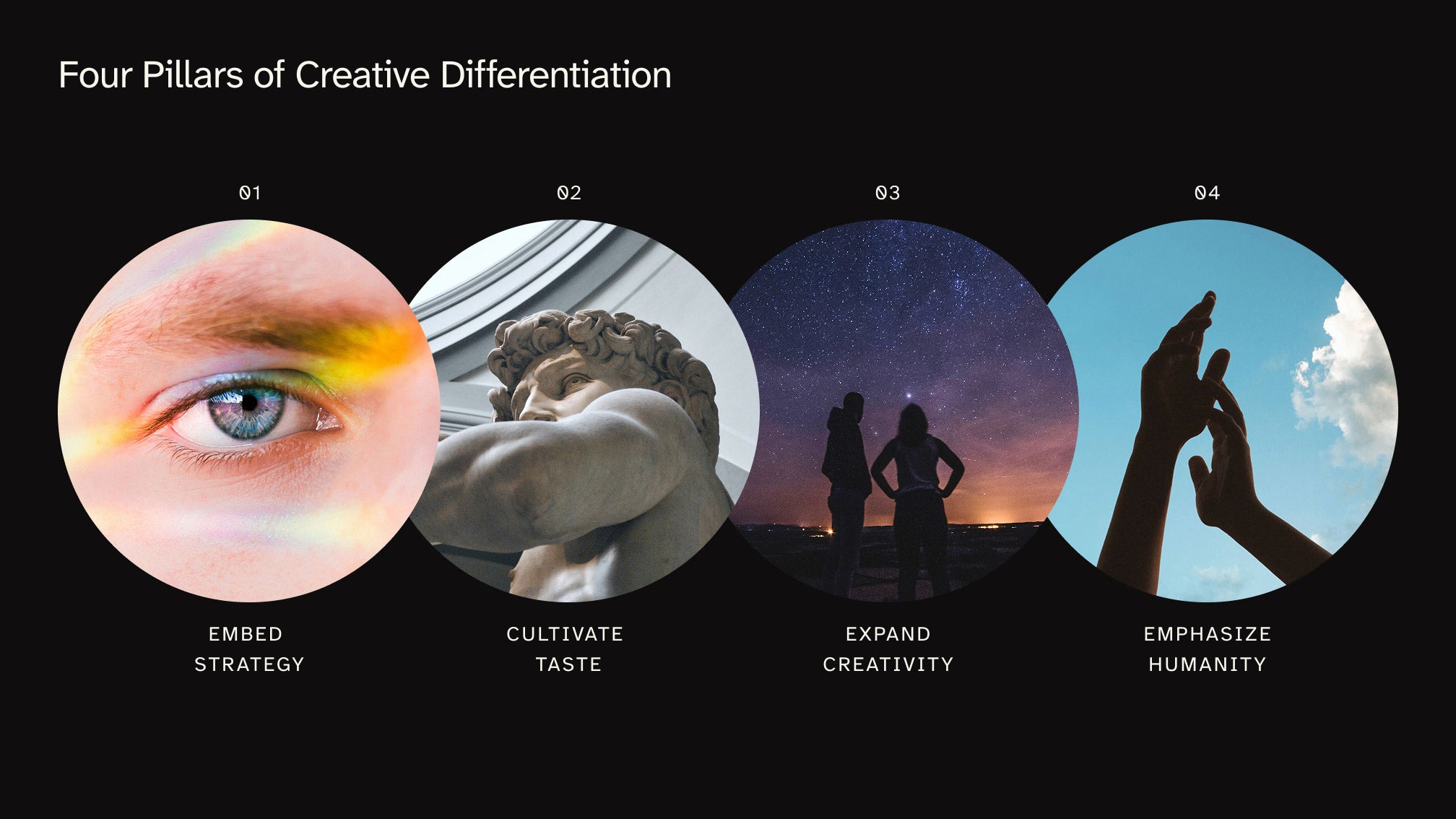
As our team and processes moved from AI-curious to AI-native but human-led, we identified one final challenge: how do we define what sets us apart from competitors and prove it? With AI lowering the barriers to production, our expertise and experience became our key differentiator. We identified four core pillars of Creative differentiation, unique to Proven and its team members:
- Embed Strategy: We go beyond execution to take the time to understand our clients’ problems, develop strategies for how to address them, and provide solutions that deliver results above expectations.
- Cultivate Taste: We expand our knowledge and range of influences, we know what is fresh and what is passé, and most importantly, we bring a point-of-view to our work.
- Expand Creativity: We go beyond the expected solution to new ideas, we create products custom-tailored for our clients, and push ourselves to create new experiences that set the trend rather than follow it.
- Emphasize Humanity: As interactions become increasingly artificial, we cultivate close, connected relationships with our clients, practice empathy for others in our work, and focus on creating authentic, emotionally resonant experiences for users.
These pillars became our guideposts for the future of design we wanted to create, one that blends human creativity with AI’s efficiency.
Better Outcomes
While others use AI to create products that look and function like everything else, we’re focused on creating products specifically designed to meet our clients’ needs and achieve their goals.
By doubling down on humanity and creativity, we aren’t just surviving the age of AI — we’re setting the new standard for it.
At the center of our work is the humanity that connects us all – including our Creative experts and yours.