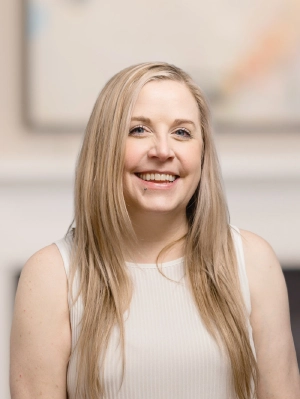

It may surprise you to learn that the COO of a tech consultancy has a BFA in Ceramics, but I do. When most people hear “ceramics,” they think of a pottery wheel but there’s a lot more range to it than that, including mold-making and slip-casting.
In my junior year of college, my program got its first 3D printer, and a few of my classmates started designing things in CAD that you could never have created by hand. They’d 3D-print the molds, slip-cast them, and end up with this pristine, complex piece. I recognized the achievement — building out intricate designs in CAD is a skill in its own right — but it was the first time I questioned whether we were pursuing achievement at the expense of artistry.
A Means of Expression
I’m a firm believer that you choose the medium based on what you want to express.
My senior thesis project was built around the idea that clay is a recording device. Like scars on our skin tell us where we’ve been, clay records a point in time. For the piece, I built saline drip devices hidden behind a wall and started them one at a time, an hour apart, dripping onto dry, unfired porcelain. You could walk in and see the progression of the bone-dry cast absorbing the saline over time, and when I fired the pieces, it created almost a fossil record of what the clay had experienced. That idea needed to be expressed through that medium; nothing else would have had the same impact.
However, if I can say something better through a painting, I’m not going to force it into clay just because that’s what I know. That sensibility struck me as I watched those 3D-printed pieces come out of the kiln, and it’s the same one that often strikes me now when considering new technology.
Technology is the medium of expression or function, not the end in and of itself.
From the Studio to Sprints
I somewhat stumbled into agency life when I answered an ad for a Studio Assistant position. In my mind, it sounded like art, but when I got there, portfolio in hand, I found they were really looking for a right hand to the CEO. That very quickly turned into being the team’s first project manager, then leading the entire project management process.
I didn’t necessarily realize at the time that by taking that first role, I was choosing to step into the technology space, and I had a bit of an identity crisis afterward. I was worried that those artistic skills and sensibilities were withering on the vine. It took time to realize that those skills hadn’t been shelved; they’d just found a new means of expression.
Art school is an intensive, insulated four-year crucible where you explore, fail, tear down, and reconstruct. That environment rewired my thought processes permanently, regardless of the industry I find myself in.
These days, my artistic instincts most often appear as taste, composition, language, curiosity, and sensitivity to human experience rather than as making traditionally creative things. Even in this technology space, I find myself shaping things — language, proportion, consistency, emotion — taking something “corporate” or “non-human” and putting humanity back into it.
Work Is Site-Specific
In public art, there’s a concept called site-specific work. You create a piece for the place that it’s meant to live, and if you take it out of that place, it’s not right anymore. Just as my thesis project wouldn’t have worked in a different medium, if it’d been done in a different environment — one where people couldn’t watch the clay change as each hour passed — it wouldn’t have told the same story.
At Proven, our approach to new tools mirrors that idea of site-specific work: we evaluate a tool before we reach for it, rather than reaching for it and looking for a problem to justify its use. We’re also not prescriptive about solutions. Each one is bespoke, built for the unique challenges and capabilities of the client and the people who will actually use it. A tool that’s exactly right for one engagement can be exactly wrong for the next, even when the two look similar on paper — the work is site-specific, and so is the solution.
That discipline cuts both ways, though. Being deliberate about what tool fits the job requires being thoughtful about which jobs are done by whom (or what).
Some Things Shouldn’t Be Optimized Away
It’s easy to mistake speed for value, achievement for artistry. The faster something can be automated, the easier it is to assume it should be. But technology should expand what we can do, not decide for us whether we should do it. Some parts of the process are worth the extra effort precisely because they’re slow.
Recruitment is the clearest example we have. We don’t run resumes through AI screening; a single person reviews every application and talks to every candidate herself. It takes real time, and it would be simpler not to. But keyword-matching software has no way to see a candidate the way a person can, and it will discard someone perfectly qualified over a technicality no human would ever flag. The expediency isn’t worth the trade-off: a real person on the other side of that resume being treated like a data point instead of a candidate.
We don’t renounce AI or automation in our processes and workflows. But we do use it deliberately, only for what it’s good at, and never where it removes humanity. That’s why our philosophy remains “AI Native, Human Led.” It’s not enough to keep a human in the loop, a human must remain the lead — because all the efficiency in the world cannot replace judgment, discernment, and empathy.
Some achievements aren’t worth what they cost in humanity, and knowing the difference is its own kind of artistry.
We don’t believe in one-size-fits-all solutions — every engagement is shaped around your organization, people, and goals. Let’s build something beautiful together.